Jun 10, 2026
Products
Often Overlooked, Dynamic Stiffness Explains Why Focusing on Static Stiffness Alone Can Limit Machine Performance
- Technical Information
- New Product
- Machine Tools
- General Industrial Machinery
- Electricity / Electronics
- Semiconductor Manufacturing Equipment
- Automotive / Automotive Component
- Conveyance
- Simulator
- Precision Machinery / Instrument
- Industrial Robots
- Transfer Robot
- Cartesian Coordinate Robot
- Articulated Robot
- High Rigidity
- FA
- High Accuracy
- High Speed
- Numerical simulation
- Automation
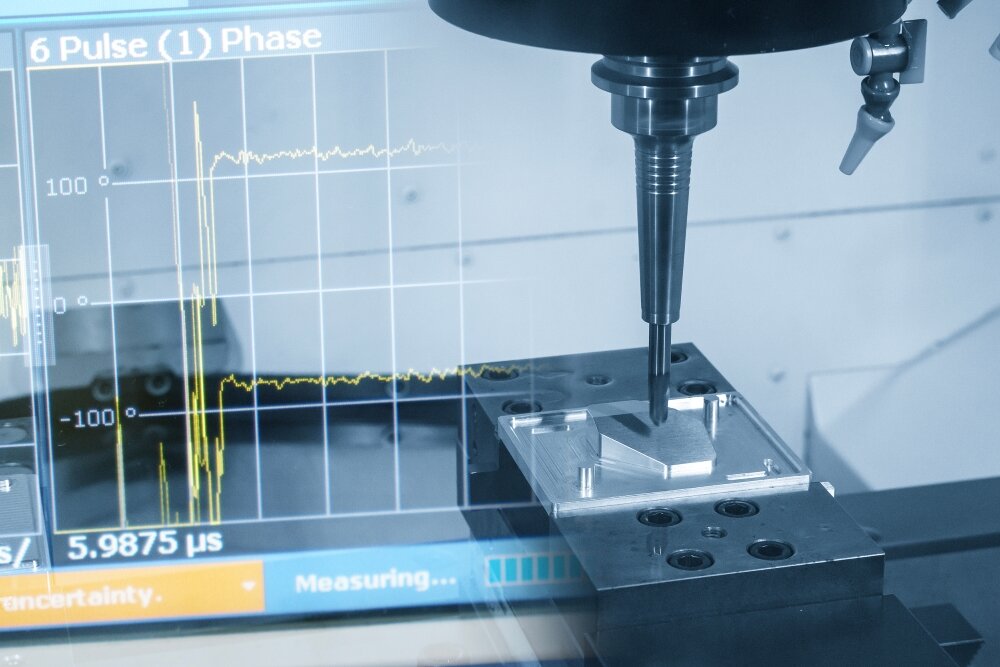
In recent years, cutting-edge fields like the semiconductor industry have seen equipment performance advance with unprecedented speed. Semiconductor devices have rapidly become smaller, ushering in an age of 2 nm logic at the forefront of semiconductor technology. As we approach line widths no more than a few dozen atoms across, positioning error of just a few nanometers and even minute vibrations have a direct impact on product yield. At the same time, lithography machines and semiconductor inspection equipment, which require nanometer-level positioning accuracy, are increasingly designed for high-speed transfer capable of accelerations greater than 1 g (or 9.8 m/s2, the acceleration caused by gravity) for the sake of further increasing output. What all this means is that product quality and production efficiency are directly impacted by even the slightest degree of displacement or the most minute of vibrations. It has thus become extremely important to design these devices in a way that minimizes these factors. In this article, we’ll take a closer look at a design concept called dynamic stiffness and the role it plays in this context.
Beyond Semiconductors: Faster, More Responsive Machines and the Dynamic Behaviors Determining Equipment Performance
The idea of designing a machine to move the way one wants it to by minimizing the influence of minute vibration, deformation, and displacement is far from limited to the semiconductor field. A machine tool, for instance, might have a high-speed spindle that rotates at a rate of 20 to 40 thousand revolutions per minute and an overall feed rate of some dozens of meters in the same period of time. In order to shorten cycle times, industrial robots are also being designed for higher acceleration to provide greater responsiveness down to the millisecond. Having automated equipment and precision transfer systems that deliver high-speed performance that is also highly responsive and highly consistent gives a company so much of a competitive edge that machine performance in general has a tremendous impact on a company’s value overall.
This has made the dynamic behavior of machines with linear motion systems at their core all the more important as a key determiner of equipment performance. After all, even a few microns of vibration or resonance can diminish the quality of a machined surface, reduce the accuracy of a machined shape, and even impede efforts to operate at higher speeds with greater accuracy altogether.
Equipment that is prone to resonance must be run slowly with little acceleration in order to avoid generating vibration. Naturally, this prevents it from performing to its full capacity, which limits how much productivity and precision can be improved. At the same time, growing market competition is driving demand for faster machine development, making the conventional practice of repeated testing and evaluation less viable as a means of delivering the required performance within an acceptable time frame. Going forward, it will be essential to restructure the development process altogether so that a machine's overall characteristics are understood from the start.

Three Types of Stiffness That Sustain Machine Performance, Including the One Often Overlooked
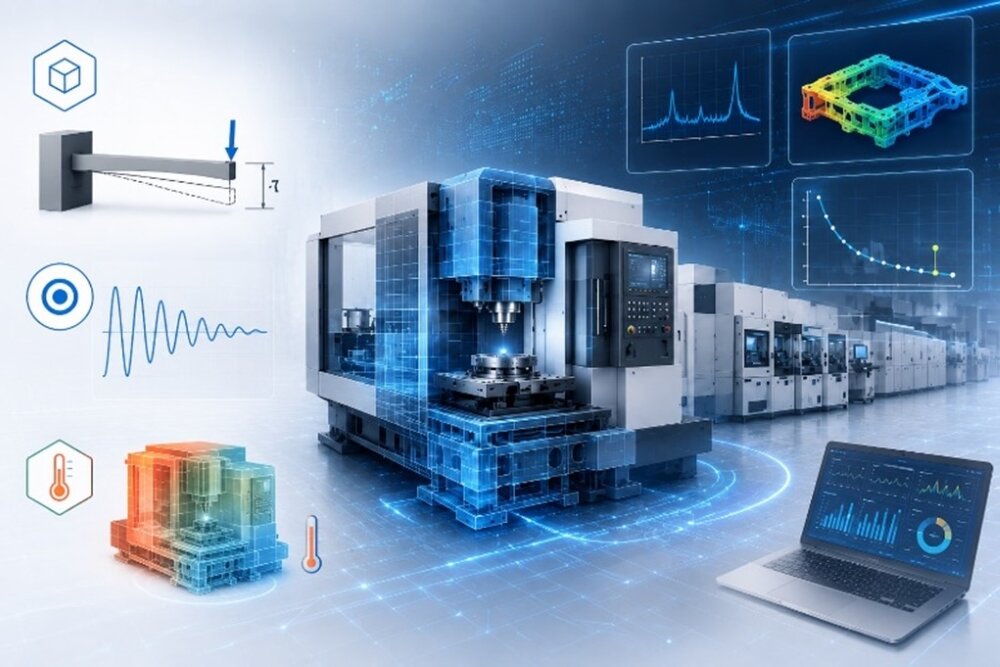
There are three types of stiffness that are critical when it comes to equipment design: static stiffness, thermal stiffness, and dynamic stiffness. While each is a fundamental factor in determining equipment performance, they cannot be considered separately; it is the combination of these interrelated elements that dictates how a machine performs.
Static stiffness represents an object’s resistance to deformation caused by external forces. It is key to minimizing deformation caused by things like cutting forces and transfer loads, and it is absolutely necessary for maintaining geometric accuracy when a load is applied. Without sufficient static stiffness, equipment will experience problems like processing and positioning error. Because of this, static stiffness is commonly taken into account beginning with the structural design and material selection phases of a project.
Thermal stiffness accounts for an object's resistance to thermal deformation caused by changes in temperature. The heat generated by motors and spindles during equipment operation, as well as changes in ambient temperature, alters the temperature distribution throughout said equipment, leading to thermal expansion within its structure. This leads to displacement that, during extended periods of operation, diminishes equipment accuracy. To avoid this, equipment designers have to figure out how to create a uniform temperature distribution with the way they place heat sources and design coolant systems.
The last form of stiffness isn’t taken into account as often as the first two. Dynamic stiffness is an object’s ability to resist structural displacement and vibration caused by external forces and vibrations that change over time. Machine tools and semiconductor manufacturing equipment alike experience dynamic loads of various frequencies coming from the revolution of motors, acceleration and deceleration of drive mechanisms, and counterforce from cutting and transfers. To make matters worse, if a structure's natural frequency is close to the excitation frequency of one of these dynamic loads, the resonance that results can translate even a tiny external force into powerful vibration and substantial displacement.
Insufficient dynamic stiffness results in chatter on machined surfaces, reduced positioning accuracy, and slower cycle times caused by residual vibration generated during transfers, all of which negatively impacts productivity and product quality. While recent years have brought increasing awareness of this, compared to static stiffness and thermal stiffness, there are still far too few instances where dynamic stiffness is approached systematically from the very first stages of equipment design. Especially considering the high-speed, high-acceleration performance of modern equipment, we see increasingly often that machine performance is limited by dynamic vibrations and resonance despite ample consideration for static stiffness during equipment design. If we assume that a machine has sufficient static stiffness, dynamic stiffness is the next deciding factor in how well that machine can perform.
The True Source of Trouble with Vibration, Quality, and Cycle Times
If you’ve ever had to deal with equipment that vibrated non-stop while running, inconsistent machining quality, and cycle times that just couldn’t be shortened, those problems could very well have been the result of overlooking dynamic stiffness when that machine was being designed.
Modern equipment is constantly being made to move faster and accelerate more swiftly. As a result, the structures of these machines are repeatedly exposed to forces that change drastically over short periods of time. Even with minimal static deformation, resonance and amplified vibration can reduce the quality of machined surfaces, cause chatter, exacerbate positioning error, and destabilize equipment control. Because dynamic stiffness is the combined result of a machine’s overall structure and vibration-damping properties as well as the rigidity of its joints rather than the contribution of individual components, it is often difficult to address a lack of dynamic stiffness with localized interventions after the testing phase of machine design is finished.
Until now, the most common approach equipment designers have taken to issues caused by vibration has been a reactive one, where problems are addressed only after they've become apparent. But this has forced them to go back to the drawing board more often, extending the development cycle overall, and caused them to prematurely reach the performance limits of what they’re designing. By contrast, if dynamic stiffness is taken into account during the design phase, more proactive conversations can be had about how to prevent resonance and reduce vibration for the sake of making a machine that consistently performs the way it should. Understanding dynamic stiffness, though, requires more than just experience and intuition. These design decisions must be based on quantitative analysis and visualization, which makes anything that can provide both of these for an entire machine incredibly valuable for those doing equipment design.
What Happens When We Visualize Dynamic Stiffness?
The trickiest thing about dynamic stiffness is that it's essentially invisible. While static stiffness can be directly assessed by looking at how much deformation occurs when force is applied, dynamic stiffness ties in the structure, joints, and vibration-damping properties of an entire machine. A designer might have a hunch that a piece of equipment will experience a lot of vibration, but it will be impossible to address without identifying its source and problematic frequency ranges.
Visualizing and quantitatively evaluating dynamic stiffness, though, allows us to see a number of things that we previously could not. We can get concrete information about what frequencies cause resonance, which parts of a machine are most susceptible to deformation, and the ways in which vibrations are transmitted or magnified throughout a device. With a clear view of these things, we can prioritize what to address and execute design changes based on solid rationale. This also allows us to use hard data rather than relying on a person’s experience or intuition when thinking about the soundness of a design.
What's more, the knowledge gained by continuing to evaluate designs this way has an impact that goes beyond a single piece of equipment, becoming a technological asset that informs a company’s design criteria going forward. This produces more accurate decisions with each successive equipment design and raises the level of a design team’s technical prowess overall.
Designing with Dynamic Stiffness in Mind: The Future of Equipment Development
In response to these challenges and imperatives, THK is developing analytics services to complement measurement and assessment of actual machines and putting in place structures to support customers in their efforts to consider dynamic stiffness from the earliest stages of equipment design. By providing the means to predict the dynamic characteristics of equipment during design, we help identify problems before the testing phase even begins, which minimizes the number of times design has to start over and shortens the design cycle overall. We take things further by combining measurement and analytics technology into an iterative cycle that contributes to continual improvement in machine performance beyond the scope of a single design project. When it comes to delivering the high accuracy and speed demanded of today's machines, designing with dynamic stiffness in mind gives a company a decisive advantage.
THK’s dynamic stiffness assessment service DYNAS directly supports such efforts. DYNAS uses assessments of actual equipment to visualize “invisible” behaviors, providing insights that can be translated directly into design improvements.
Please feel free to reach out to THK to get things started with an assessment of your equipment’s dynamic stiffness.
* The DYNAS system for measuring dynamic stiffness may not be available in some regions depending on the supply structure. Contact THK for details.
* This content is based on information that was released in Japanese on June 10, 2026.