Apr 15, 2026
Products
Using Computer-Aided Engineering for More Efficient LM Guide Design and Development

Machine components are fundamental to the function and performance of machine tools and other types of equipment, directly impacting how they operate and how durable and efficient they can be. From bearings and gears to nuts, bolts, and beyond, each carries out a specific function and is indispensable for the safe and proper functioning of complex equipment.
The LM Guide, for its part, plays a critical role in ensuring the accuracy, operational stability, and efficiency of equipment, and it is used in an increasingly wide range of applications. Product development for the LM Guide has to balance product accuracy, stability, durability, and reliability with various customer requirements and the constant imperative to bring new products to the market quickly. This makes it essential to reduce development and design time wherever possible.
Those directly involved in product design, however, find themselves frequently having to go back to the drawing board, spending too much time prototyping and testing, and just wishing the development cycle were shorter. For example, having to return to the design phase late in the development process because a problem went undiscovered until then can have a large impact on development time and costs. A method that has attracted considerable attention as an answer to these challenges is something called computer-aided engineering (CAE). CAE makes it possible to predict and work around potential problems before the design phase is even finished. In this article, we’ll look at how CAE is used as a problem-solving tool during the product development cycle.
What Is Computer-Aided Engineering?
Computer-aided engineering (CAE) is an umbrella term for various technologies and methods that utilize computers to perform engineering analyses and simulations. Some of its main uses are for things like structural analysis, which evaluates product strength, stress, and warping, and dynamic analysis, which looks at how an object’s behavior changes with time and the results of things like collisions. The greatest advantage CAE offers, though, is the ability to evaluate product performance using a computer simulation before physically making the product itself.
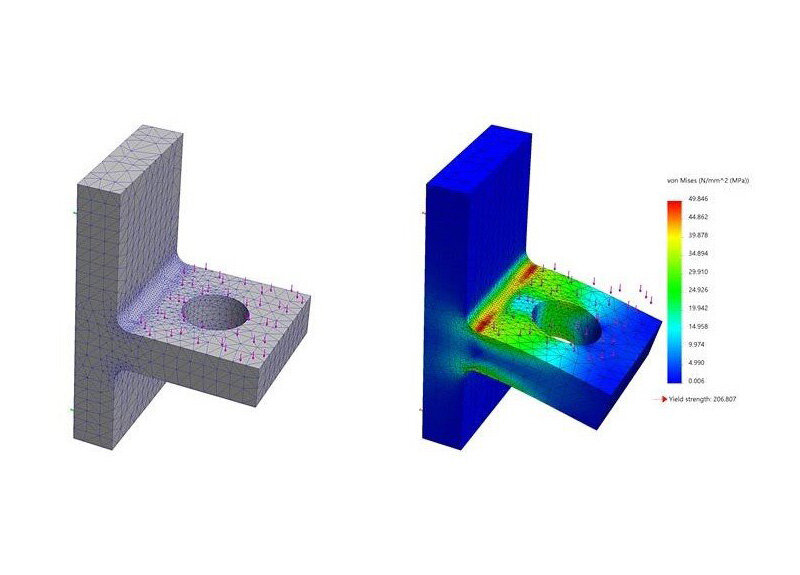
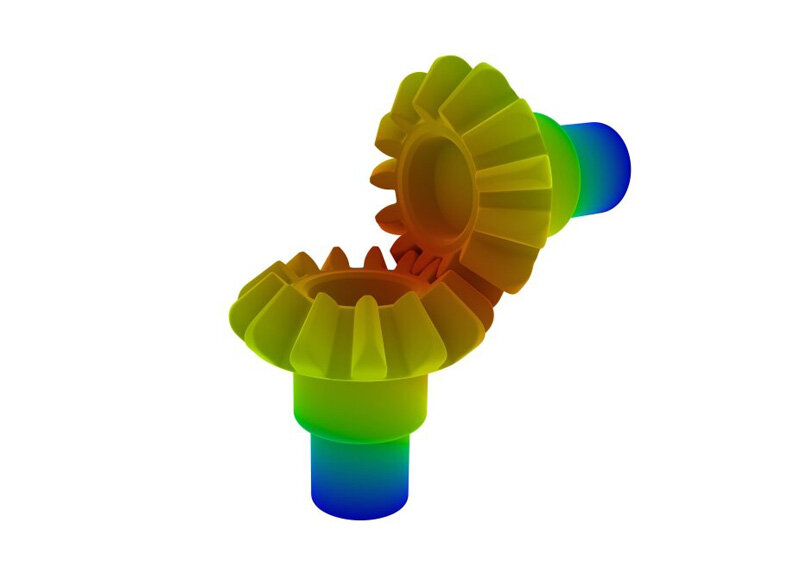
Put another way, CAE is a technology that allows trials and evaluations to take place before an object even exists. This is what makes it possible to discover issues at the design phase that traditionally would have gone unnoticed until after a trial was conducted.
Using CAE During Product Development
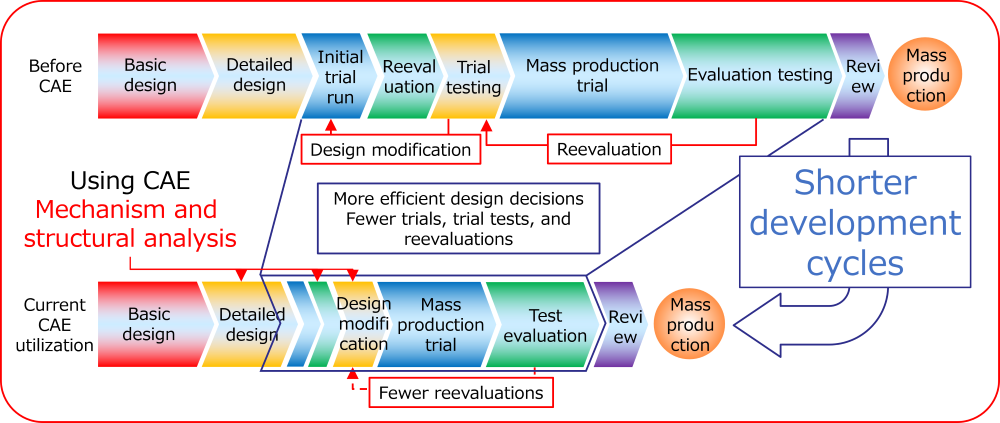
Conventional product development is a reiterative cycle that starts with design and proceeds through trial and evaluation. The cycle continues until a prototype is found to be successful, which at times involves considerable time and expense. This is where CAE is crucial for the product development process. Using CAE makes it possible to identify and resolve issues early on in the product design phase, which reduces the number of trials and evaluations that need to be done and saves both time and money. It can also be used to go a step further by simulating the loads a product might bear and conditions that would be difficult to recreate that it might experience in a variety of operating environments. Being able to discover potential risks associated with a product this way helps to improve product safety and performance. All this means that CAE promises to shorten development cycles without sacrificing the durability and reliability of the end product.
Using CAE in LM Guide Development
LM Guide Structure and the Role of Circulation Components
Let’s look at how CAE was used to develop circulation components for high-speed LM Guide performance.
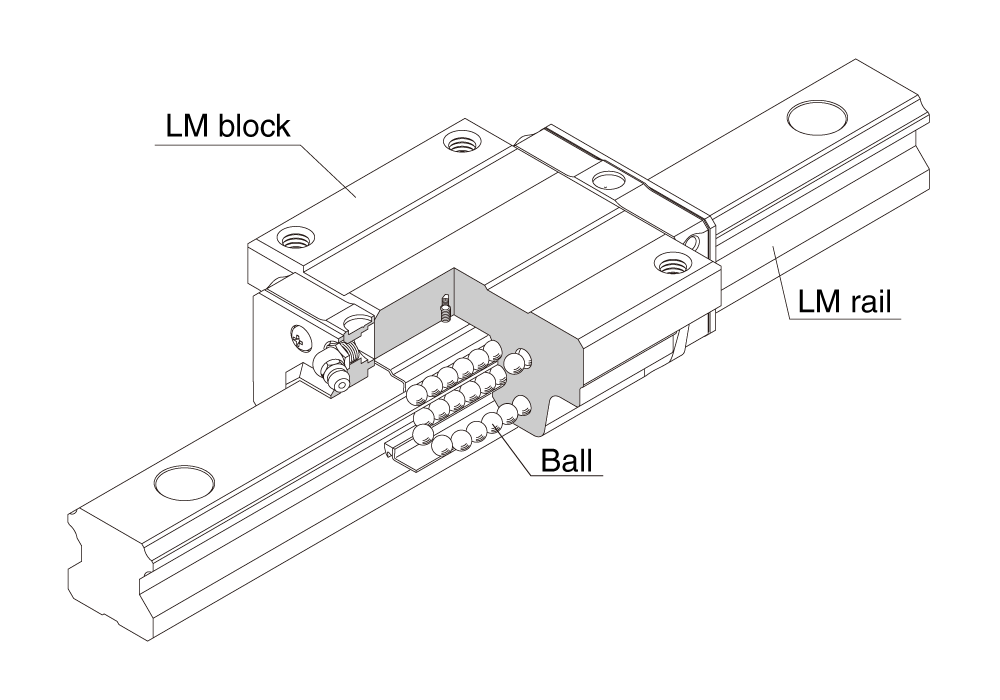
The three main elements of an LM Guide are the LM rail, the LM block, and balls (rolling elements). It’s the rolling of these balls, sandwiched between the LM rail and the LM block, that provides smooth linear motion. Circulation components attached to both ends of the LM block reverse the direction the balls are traveling so that they can recirculate endlessly inside the LM block, allowing it to move back and forth freely across the LM rail.
Obstacles to Achieving High-Speed Performance
These circulation components are critical for allowing an LM Guide to move at high speeds. Because balls are constantly colliding with them, they have to be strong and durable to begin with. High-speed motion makes these collisions even more forceful, so new circulation components have had to be designed and developed to withstand higher speeds. While it would have been no easy task trying to use theoretical formulas to calculate how forcefully rolling elements collide with circulation components when an LM Guide moves at high speeds, performing the multiple trials and evaluations required to provide more reliable results could have ended up making the development process considerably longer.
Approaching the Problem with CAE: Combining Mechanism Analysis with FEM Structural Analysis
For this particular product development, we employed CAE in the form of both mechanism analysis, which can be used to evaluate the dynamic behavior of objects, and FEM structural analysis, which can be used to evaluate stress and warping. Using mechanism analysis, we can simulate an LM Guide moving at high speeds to see how the balls behave while they’re circulating, where they collide with the circulation components (both of which are difficult to observe outside of simulations), and to understand the applied load generated by those collisions. This allows us to make inferences about product performance and problem areas without making a single prototype so that we can formulate proactive responses that ultimately accelerate the development process.
Simulation of Full-Ball LM Guide behavior
Simulation of Caged Ball LM Guide behavior
By taking the information we obtained from mechanism analysis to perform structural analysis simulations, we can see the stress experienced by the circulation components under conditions that are even closer to what they would be during actual operation. As a result, we can infer things about the strength and durability of these components without having to run a single real-life test, which should shorten the testing period overall while increasing the reliability of the circulation components themselves.
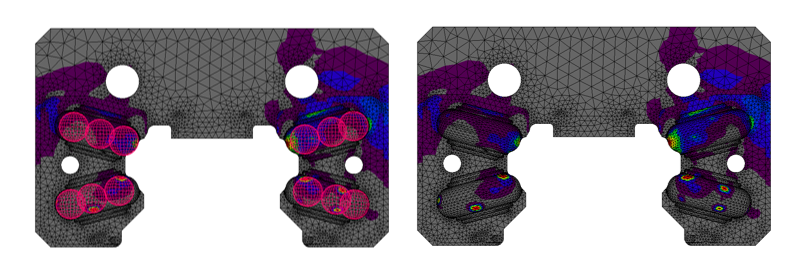
All of this speaks to the power of CAE to help shorten the development cycle and get products to market faster without sacrificing product performance, consistency, durability, or reliability.
CAE Brings Change and Added Value for Engineers
CAE is changing the way we do product development. It’s steering us away from the conventional reactive approach of using insights from trials and evaluations to go back and modify initial designs, and toward a more proactive one where we use CAE to foresee problems during the design phase and address them ahead of time. As a result, we’ve been able to reduce the number of times we have to go back to the design phase and the number of trials we have to perform, which has led to a shorter development cycle and more consistent quality. Using CAE isn’t just making the development process more efficient, though; it’s also drastically changing the shape of the design work that engineers do.
Being able to visualize things that are otherwise difficult to see, like the way objects behave and how load is distributed inside the LM Guide, makes the reasoning for certain design decisions more clear-cut and makes the decisions themselves more accurate. With the ability to do testing during the design phase, we’re able to dedicate more time to more value-added design considerations. CAE is more than just a tool for analysis; it’s a crucial method for enhancing the quality of our designs.
Expanding CAE Utilization and Looking Ahead
Computer-aided engineering can be used for far more than mechanism and structural analysis. Its applications span a wide range of fields that include thermal fluid analysis and acoustic analysis as well. These could prove useful beyond the product design process and might even contribute to improvements to manufacturing processes. At THK, we’re expanding our utilization of CAE to enhance product performance and drive efficiency in our development process, all with the aim of providing customers with products of higher quality ever faster than before.
Figuring out how to shorten design and development time and reduce backtracking is a challenge faced by many in the manufacturing industry. Computer-aided engineering promises to be an increasingly important and effective way of addressing it. It's worth considering where CAE could be used for your products and design processes. Even such a small step forward can lead to more efficient development of even higher-quality products.
Overview of THK Online Services (THK website)
THK Online Services features technical support tools for the THK product catalog and instruction manuals, CAD data, product FAQ, technical materials, product selection, and service life calculation.
* Those who do not have an ID must register for a free account before using.
* There are two types of members (full members and guest members).
* This content is based on information that was released in Japanese on April 15, 2026.