Static Safety Factor
During actual operation, damage may occur from an unexpectedly large load acting on the cross-roller ring that is caused in particular by sudden starting and stopping, vibrations due to a cutting load, or a large moment created by an overhang. Therefore, a static safety factor (fs) must be considered. The static safety factor (fs) is obtained from the following formula based on the relationship between the applied load and the basic static load rating. Estimates for the static safety factor are shown in Table 1.

| fS | Static safety factor (see Table1 ) |
|---|---|
| C0 | Basic static load rating (N) |
| P0 | Static equivalent radial load (N) |
Table1: Static Safety Factor (fs) (Guideline)
| Load conditions2 | Lower limit of fs |
|---|---|
| Without vibrations or impacts | 2 |
| With vibrations or impacts | 5 |
- 1 The basic static load rating C0 is a static load of a defined direction and size where the calculated contact stress of the roller and the raceway at the contact area under maximum load is 4,000 MPa. (If the contact stress exceeds this level, it will affect the rotation.) This load is indicated as C0 in the respective dimensional tables.
- 2 In general, factors that cause vibration and impacts include acceleration and deceleration, sudden starts and stops, transmission of vibration and impacts from external devices and machines, and changes in processing force over time.
- 3 The values in the table above are guidelines for minimum static safety factors. However, considering dynamic performance such as service life, we recommend a value of 7 or above.
Static Equivalent Radial Load P0
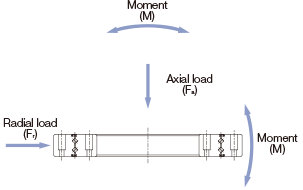
The static equivalent radial load of the Cross-Roller Ring is obtained from the following equation.

| P0 | Dynamic equivalent radial load (N) |
|---|---|
| Fr | Radial load (N) |
| Fa | Axial load (N) |
| M | Moment (N・mm) |
| X0 | Static radial factor (X0=1) |
| Y0 | Static axial factor (Y0=0.44) |
| dp | Roller pitch circle diameter (mm) |