Rated Load and Nominal Life
Static Safety Factor fS
The Flat Roller may receive an unexpected external force while it is stationary or operative due to the generation of an inertia caused by vibrations and impact or start and stop. It is necessary to consider a static safety factor against such a working load.

| fS | Static safety factor |
|---|---|
| fH | Hardness factor (see Fig.1) |
| fT | Temperature factor (see Fig.2) |
| fC | Contact factor (see [Load Rating] and [Nominal Life]) |
| C0 | Basic static load rating (kN) |
| PC | Calculated radial load (kN) |
Estimates of the Static Safety Factor
Treat the values in Table1 as estimates for the lower limit of the static safety factor based on the operating conditions.
| Machine using the LM system |
Load conditions1 | Lower limit of f S |
|---|---|---|
| General industrial machinery |
Without vibration or impact | 1 to 1.3 |
| With vibration or impact | 2 to 3 | |
| Machine tool | Without vibration or impact | 1 to 1.5 |
| With vibration or impact | 2.5 to 7 |
1Vibrations and impacts are typically caused by factors such as acceleration and deceleration, sudden starting and stopping, vibrations and impacts from an external machine, and changes in processing power over time.
Load Rating
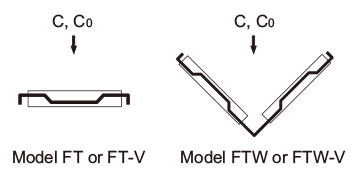
The rated loads shown in the specification tables represent the rated loads with a unit length (ℓ) in the directions indicated in the figure below.
If the length of the Flat Roller in the effective load range differs from the unit length (ℓ), approximate rated loads (Cℓ and C0ℓ ) can be obtained using the following equation.
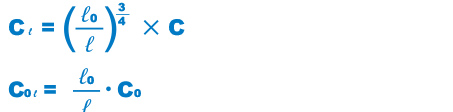
| Cℓ | Basic dynamic load rating in the effective load range (kN) |
|---|---|
| ℓ0 | Length in effective load range (mm) |
| ℓ | Unit length (see the specification table) (mm) |
| C0ℓ | Basic static load rating in the effective load range (kN) |
| C | Basic dynamic load rating (kN) |
| C0 | Basic static load rating (kN) |
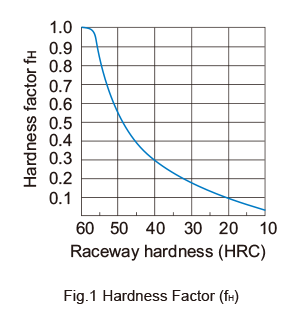
Note: Note that if the hardness of the raceway is lower than 58 HRC, the rated loads will be decreased. (See Fig.1.)
Nominal Life
When the basic dynamic load rating (Cℓ) of the Flat Roller in the effective load range has been obtained from the equation above, the nominal life is obtained using the following equation.
Calculating the Nominal Life
The nominal life of the THK flat roller is defined as 100 km. The nominal life (L10) is calculated from the basic dynamic load rating (C) and the load acting on the flat roller (PC) using the following formula.

| L10 | Nominal life (km) |
|---|---|
| C | Basic dynamic load rating (N) |
| PC | Calculated radial load (N) |
When comparing the nominal life (L10), you must take into account whether the basic dynamic load rating was defined based on 50 km or 100 km. Convert the basic dynamic load rating based on ISO 14728-1 as necessary. ISO-regulated basic dynamic load rating conversion formula:

| C50 | Basic dynamic load rating based on a nominal life of 50 km |
|---|---|
| C100 | Basic dynamic load rating based on a nominal life of 100 km |
Calculating the Modifi ed Nominal Life
During use, a flat roller may be subjected to vibrations and shocks as well as fluctuating loads, which are difficult to detect. In addition, the hardness of the raceways, the operating temperature, and having flat rollers arranged in close contact will have a decisive impact on the service life. Taking these factors into account, the modified nominal life (L10m) can be calculated according to the following formula (2).
Modifi ed factor α

| α | Modified factor |
|---|---|
| fH | Hardness factor (see Fig.1) |
| fT | Temperature factor (see Fig.2) |
| fC | Contact factor Note) |
| fW | Load factor (see Table 3) |
Modified nominal life L10m

| L10m | Modified nominal life (km) |
|---|---|
| C | Basic dynamic load rating (N) |
| PC | Calculated radial load (N) |
Note: Contact factor is determined according to the contact state of the two planes between which the rollers travel. If the contact ratio between the two planes is 50%, set the contact factor as fC=0.5 for safety’s sake.
Calculating the Service Life Time
When the nominal life (L10) has been obtained, if the stroke length and the number of reciprocations per minute are constant, the service life time is obtained using the following equation.

| Lh | Service life time (h) |
|---|---|
| ℓS | Stroke length (mm) |
| n1 | Number of reciprocations per minute (min-1) |
fH : Hardness Factor
To maximize the load capacity of the LM sys- tem, the hardness of the raceways needs to be between 58 to 64 HRC. If the hardness is lower than this range, the basic dynamic load rating and the basic static load rating decrease.Therefore, it is necessary to multiply each rating by the respective hardness factor (fH).
fT : Temperature Factor
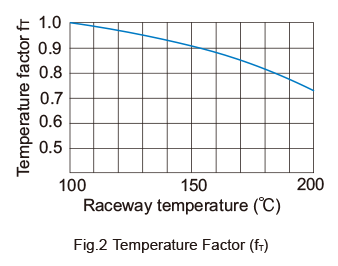
If the temperature of the environment surrounding the operating Flat Roller exceeds 100°C, take into account the adverse effect of the high temperature and multiply the basic load ratings by the temperature factor indicated in Fig.2 .
Note: If the environment temperature exceeds 100℃, contact THK.
fW : Load Factor
In general, reciprocating machines tend to experience vibrations or impacts during operation, and it is difficult to accurately determine the vibrations generated during high-speed operation and impacts during frequent starts and stops.Therefore, when the actual load applied cannot be obtained, or when speed and impacts have a significant influence, divide the basic dynamic load rating (C) by the corresponding load factor in Table 2 , which has been empirically obtained.
| Vibrations/ impact |
Speed(V) | fW |
|---|---|---|
| Faint | Very low V≦0.25m/s |
1 to 1.2 |
| Weak | Slow 0.25<V≦1m/s |
1.2 to 1.5 |
| Medium | Medium 1<V≦2m/s |
1.5 to 2 |
| Strong | High V>2m/s |
2 to 3.5 |
