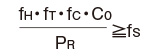
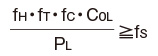
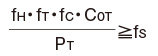
During actual operation, damage may be caused by an unexpectedly large load acting on the LM Guide that is caused by particularly sudden starting and stopping, vibrations due to a cutting load, or a large moment created by an overhang. Therefore, a static safety factor (fS) must be considered. The static safety factor (fS) is obtained from the formulas in Table 9 based on the relationship between the applied load and the basic static load rating. Estimates for the static safety factor based on operating conditions are shown in Table 10. In addition, the static safety factor (fS) must also be considered for each direction (radial, reverse-radial, and horizontal) individually.
- 1
The basic static load rating is a static load with a constant direction and size where the sum of the permanent deformation of the rolling element and that of the raceway on the contact area under the maximum stress is 0.0001 times the rolling element diameter.
- 2
Vibrations and impacts are typically caused by factors such as acceleration and deceleration, sudden starting and stopping, vibrations and impacts from an external machine, and changes in processing power over time.