Selecting a Nut
Types of Nuts
The nuts of ball screws are categorized by ball circulation method into return-pipe nuts, the return-piece nuts, the deflector nuts, the end-cap nuts, and the end-piece nuts. The five ball circulation methods used for ball screw nuts are described below.
In addition to the circulation methods, the ball screws are also categorized by the preloading method.
Types by Ball Circulation Method
Return-Pipe Nuts (Models SBN-V (Medium), BIF-V(Medium), BIF, BNF-V (Medium), BNF, BNFN-V (Medium), BNFN, BNT, BTK-V)
These commonly used nuts use return pipes for ball circulation. Balls are scooped up from the screw shaft by the return pipe, then pass through it and return to their original positions to recirculate endlessly.

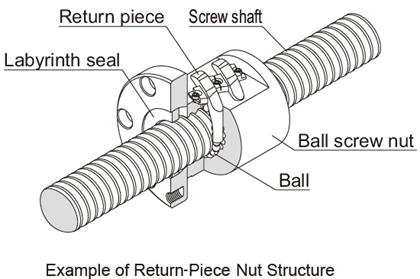
Return-Piece Nuts (Models SBN-V (Small), HBN, BIF-V(Small), BNF-V (Small), BNFN-V (Small))
These commonly used nuts use return pieces for ball circulation. Balls are scooped up from the screw shaft by the return piece, then pass through it and return to their original positions to recirculate endlessly.
Deflector Nuts: Small Lead (Models EBB-V, EPB-V, DK, DKN, DIK, MDK, DIR, and JPF)
These are the most compact type of nut. The balls change their travel direction with a deflector, pass over the circumference of the screw shaft, and return to their original positions to circulate endlessly.

End-Cap Nuts: Large lead (Models SBK, SBKN, SBKH, WHF, BLK, WGF, BLW, WTF, CNF, and BLR)
These nuts are the most suitable for fast feed. The balls are picked up with an end cap, pass through a hole in the nut, and return to their original positions to circulate endlessly.

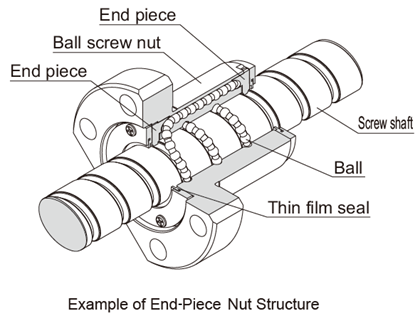
End-Piece Nuts (Models SDA-V, and SDAV-V)
These nuts are suitable for a wide range of leads. Like end cap-type nuts, they are suited to high-speed feeding. Balls are scooped up from the screw shaft tangentially, pass through a hole in the nut, and return to their original positions to recirculate endlessly.
Types by Preloading Method
Fixed-Point Preloading
Double-Nut Preload (Models SBKN, SDAN-V, BNFN-V, BNFN, DKN, and BLW)
A spacer is inserted between two nuts to provide a preload.

Offset Preload (Models SBK, SBN-V, BIF-V, BIF, EPB-V, DIK, and DIR)
More compact than the double-nut method, offset preloading provides a preload by changing the groove pitch of the nut without using a spacer.

Constant Pressure Preloading (Model JPF)
With this method, a spring structure is installed almost in the middle of the nut, and it provides a preload by changing the groove pitch in the middle of the nut.

Structure and Features of Offset-Preload Simple-Nut Ball Screws
The simple-nut ball screw is an offset-preload type in which a phase is provided in the middle of a single ball screw nut, and an axial clearance is set at a below-zero value (under a preload).
The simple-nut ball screw has a more compact structure and allows smoother motion than the conventional double-nut type (spacer inserted between two nuts).
Comparison between the Simple Nut and the Double-Nuts
| Simple-nut ball screw | Conventional double-nut ball screw |
|---|---|
 |
 |
| Preload Structure | |
 |
 |
| Rotational performance | |
|
The offset preload of simple-nut ball screws is adjusted by changing the ball diameter. This eliminates the inconsistency in the contact angle, which is the most important factor in ball screw performance. It also ensures high rigidity, smooth motion, and high wobbling accuracy.  |
In double-nut ball screws, poor flatness in the spacer surface and inaccurate perpendicularity in the nut can cause inconsistency in the contact angle. This results in a non-uniform ball contact, inferior rotational performance, and low wobbling accuracy.  |
| Dimensions | |
|
Since simple-nut ball screws are based on a preloading mechanism that does not require a spacer, the overall nut length can be kept short. As a result, the whole nut can be designed to be light and compact.  |
 |
Comparison between the Simple-Nut Offset Preload and Oversized-Ball Preload
| Simple-nut ball screw Model DIK | Conventional oversized-ball-preload-nut ball screw Model BNF |
|---|---|
 |
 |
| Preload Structure | |
 |
 |
| Accuracy Life | |
|
Simple-nut ball screw Model DIK has a similar preloading structure to that of the double-nut type although the former only has one ball screw nut. As a result, no differential slip or spin occurs, thus minimizing the increase in the rotational torque and the generation of heat. Accordingly, a high level of accuracy can be maintained over a long period.  |
With an oversized-ball-preload nut, preload is provided through each of the balls in contact with the raceway at four points. This causes differential slip and spin which increase the rotational torque, resulting in accelerated wear and heat generation. Therefore, the accuracy deteriorates in a short period.  |
Selection Criteria
- Operating Conditions of the Ball Screw
- Operating Conditions of the Ball Screw
- Selecting a Screw Shaft
- Selecting lead・Selecting a shaft diameter
- Mounting Procedure for the Ball Screw Shaft
- Permissible Axial Load
- Permissible Rotational Speed
- Selecting a Nut
- Calculating the Permissible Axial Load
- Considering the Service Life
- Considering the Rigidity
- Considering the Positioning Accuracy
- Considering the Rotational Torque
- Considering the Driving Motor
