Considering the Rotational Torque
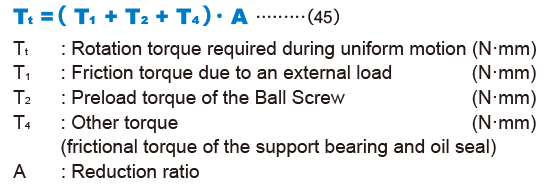
The rotational torque required to convert rotational motion of the ball screw into straight motion is obtained using equation (45) below.
During Uniform Motion
During Acceleration

During Deceleration

Frictional Torque Due to an External Load
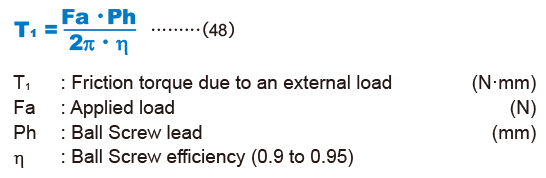
Of the turning forces required for the ball screw, the rotational torque needed for an external load (guide surface resistance or external force) is obtained using equation (48) below.
Torque Due to a Preload on the Ball Screw
For a preload on the Ball Screw, see "Preload Torque" on Preload.
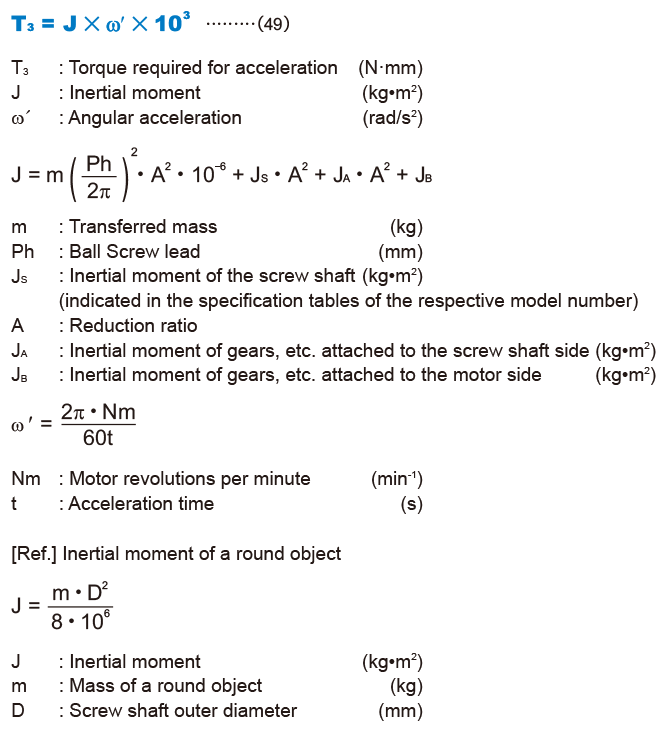
Torque Required for Acceleration
Considering the Strength of Ball Screw Shafts Ends
When torque is conveyed through the screw shaft in a ball screw, the strength of the screw shaft must be taken into consideration since it experiences both torsion load and bending load.
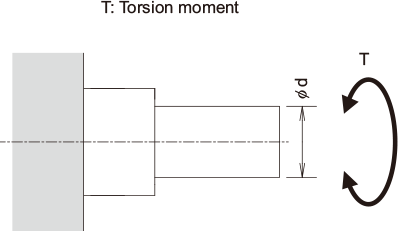
Screw Shaft Subjected to Torsion
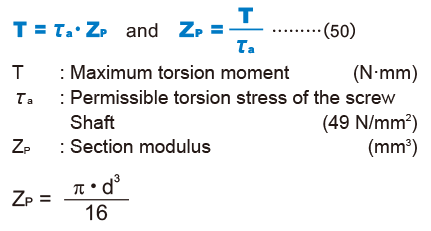
When torsion load is applied to the end of a ball screw shaft, use equation (50) to obtain the end diameter of the screw shaft.
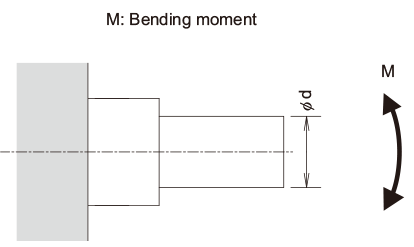
Screw Shaft Subjected to Bending
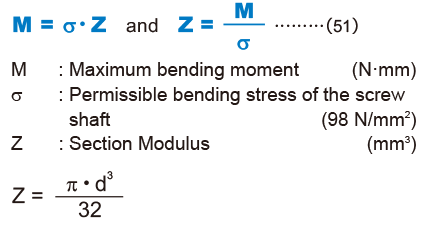
When bending load is applied to the end of a ball screw shaft, use equation (51) to obtain the end diameter of the screw shaft.
Screw Shaft Subjected to Both Torsion and Bending
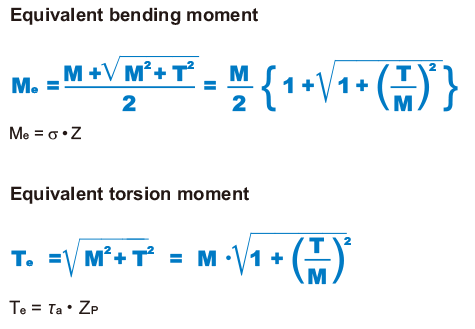
When torsion load and bending load are both applied simultaneously to the end of a ball screw shaft, calculate the diameter of the screw shaft separately for each, taking into consideration the corresponding bending moment (Me) and the corresponding torsion moment (Te). Then calculate the thickness of the screw shaft and use the largest of the values.
Selection Criteria
- Operating Conditions of the Ball Screw
- Operating Conditions of the Ball Screw
- Selecting a Screw Shaft
- Selecting lead・Selecting a shaft diameter
- Mounting Procedure for the Ball Screw Shaft
- Permissible Axial Load
- Permissible Rotational Speed
- Selecting a Nut
- Calculating the Permissible Axial Load
- Considering the Service Life
- Considering the Rigidity
- Considering the Positioning Accuracy
- Considering the Rotational Torque
- Considering the Driving Motor
