Considering the Driving Motor
When selecting a driving motor required to rotate the ball screw, normally take into account the rotational speed, rotational torque, and minimum feed amount.
When Using a Servomotor
Rotational Speed
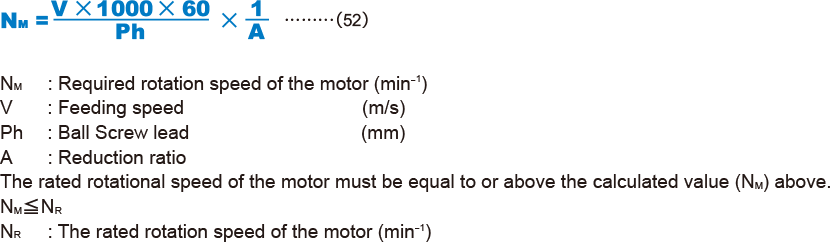
The rotation speed required for the motor is obtained using the equation (52) based on the feed speed, ball screw lead and reduction ratio.
Required Resolution
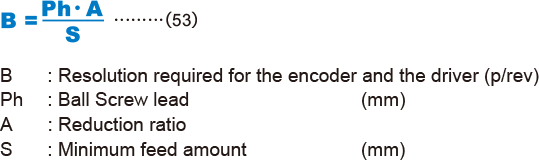
Resolutions required for the encoder and the driver are obtained using equation (53) based on the minimum feed amount, ball screw lead, and reduction ratio.
Motor Torque
The torque required for the motor differs between uniform motion, acceleration, and deceleration. To calculate the rotational torque, see "Considering the Rotational Torque" .
- Maximum torque
The maximum torque required for the motor must be equal to or below the maximum peak torque of the motor.
Tmax ≦ Tpmax
Tmax: Maximum torque acting on the motor
Tpmax: Maximum peak torque of the motor - Effective torque value
The effective value of the torque required for the motor must be calculated. The effective value of the torque is obtained using equation (54).
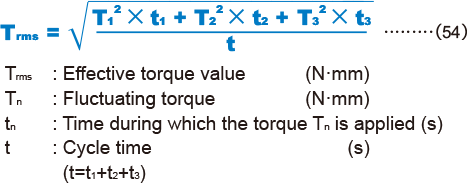
The calculated effective value of the torque must be equal to or below the rated torque of the motor.
Trms ≦ TRTR: Rated torque of the motor (N・mm)
Inertial Moment
The inertial moment required for the motor is obtained using equation (55).
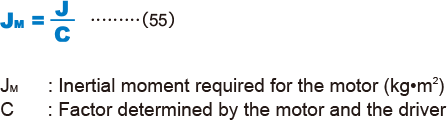
(It is normally between 3 to 10. However, it varies depending on the motor and the driver. Check the specific value in the motor manufacturer's catalog.)
The inertial moment of the motor must be equal to or above the calculated JM value.
When Using a Stepping Motor (Pulse Motor)
Minimal Feed Amount (per Step)
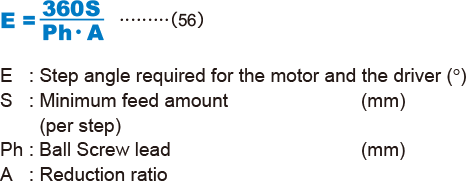
The step angle required for the motor and the driver is obtained using equation (56) based on the minimum feed amount, ball screw lead, and reduction ratio.
Pulse Speed and Motor Torque
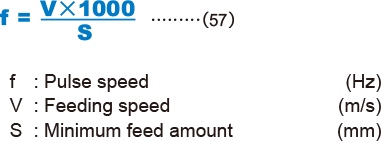
- Pulse speed: The pulse speed is obtained using equation (57) based on the feed speed and the minimum feed amount.
- Torque required for the motor: The torque required for the motor differs between the uniform motion, the acceleration, and the deceleration. To calculate the rotational torque, see "Considering the Rotational Torque".
Thus, the pulse speed required for the motor and the required torque can be calculated in the manner described above. Although the torque varies depending on the motors, normally the calculated torque should be doubled to ensure safety. Check if the torque can be used in the motor’s speed-torque curve.
Selection Criteria
- Operating Conditions of the Ball Screw
- Operating Conditions of the Ball Screw
- Selecting a Screw Shaft
- Selecting lead・Selecting a shaft diameter
- Mounting Procedure for the Ball Screw Shaft
- Permissible Axial Load
- Permissible Rotational Speed
- Selecting a Nut
- Calculating the Permissible Axial Load
- Considering the Service Life
- Considering the Rigidity
- Considering the Positioning Accuracy
- Considering the Rotational Torque
- Considering the Driving Motor
