Recycling and Conserving Resources / Sustainable Procurement / Managing Harmful Substances
Recycling and Conserving Resources
Metrics and targets
Maintain zero emissions
Zero emissions: An emissions rate (volume of waste disposed/total discharged) of less than 0.50%.
Results
Maintained zero emissions
(emissions rate: 0.28%)
Initiatives for Achieving Zero Emissions
With our initiatives for achieving zero emissions, we aim to reduce all forms of waste we generate to zero. We promote zero emissions activities through controlling the use of direct and indirect materials, emissions and final waste, and reusing and recycling.
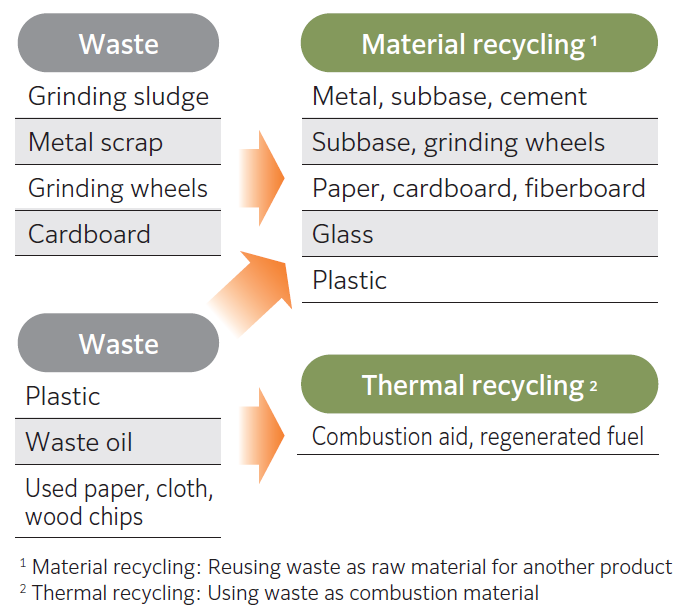
The waste produced by our business activities includes metal scrap, oil and liquid waste, grinding sludge, packaging, and plastic waste. By thoroughly separating our waste, we make it possible to reuse or transform it into usable materials, such as steel-making material, cement material, and recycled fuel. Reducing plastic waste has garnered particular attention in recent years. THK is making steady strides in reducing the amount of plastic waste we generate by reusing and recycling plastics used in our production processes and utilizing returnable boxes that can be reused.
THK Japan aims for an emissions rate (volume of waste disposed/total discharged) of less than 0.50%.
Waste Recycling Methods
Sustainable Procurement
Metrics and targets
- Distribute sustainable procurement guidelines to suppliers
- Conduct interviews and questionnaire-based surveys
Results
- Continued to distribute the current version of the CSR Procurement Guidelines to suppliers
- Conducted four supplier interviews based on the current version of the CSR Procurement Guidelines
- Currently revising sustainable procurement guidelines
Partnership Building Declaration
THK considers suppliers to be valuable partners for ensuring mutual growth. As we share the common goal of continuing to provide customers with satisfying products, we provide forums for sharing information about new technology, production methods, and materials and build collaborative frameworks to promote product improvements.
Establishing and Distributing CSR Procurement Guidelines
Based on our belief that efforts at every step of the supply chain are essential to the promotion of CSR activities, we distribute our CSR Procurement Guidelines to our suppliers and request that they actively engage in CSR activities.
CSR Procurement Guidelines (31KB)
Managing Harmful Substances
Metrics and targets
Distribute green procurement guidelines and obtain certificates of nonuse
Results
Obtained certificates of non-use that conformed with our green procurement guidelines from 258 companies
Policy
Environmentally hazardous materials are defined as materials that may be harmful to the human body or ecosystems when contained in a product. In principle, we prohibit the use of such materials in our components and raw materials. For hazardous substances that may be present as impurities, we have established tolerances and handle such materials accordingly.
Managing Harmful Substances
The THK Group Green Procurement Guidelines are used to ensure compliance with national and regional laws and regulations, including the Restriction of Hazardous Substances Directive (RoHS) and the REACH Regulation in Europe and the Administrative Measure on the Control of Pollution Caused by Electronic Information Products in China. These guidelines allow us to promote proper management of harmful substances throughout our supply chain. Standardizing the use of chemSHERPA (a communications architecture for sharing information about the chemical composition of products) alongside our internally developed database in our
procurement of harmful substances also allows us to provide customers with any information they require. We also submit reports to the relevant authorities as appropriate.
THK additionally maintains internal standards and performs risk assessments for unregulated substances in anticipation of stricter regulatory policies in the future. In so doing, we aim to contribute to environmental conservation to an even greater degree than required by law.
Going forward, THK will continue to monitor regulatory trends and strengthen collaboration with suppliers and partner companies to build a more sustainable production structure while reducing our environmental impact.