Risk Management
Metrics and targets
Continue conducting annual risk assessments
Results
Annual assessment performed for 29 departments within THK Japan and 29 Group companies within and outside of Japan
Our Philosophy
If we are to adopt a rigorous governance style of bold, proactive risk-taking, it is crucial that this be supported by a management team that actively engages with the risk management process.
We understand that each risk we take involves uncertainty as to how it will affect the profitability of our company, so we hedge risks as appropriate to deal with the negative possibilities while actively taking certain risks for the positive outcomes they may yield.
Risk Management Structure
The Risk Management Department was established directly beneath the President as a means to control and respond to risk throughout the company. It serves as the central driving force in our efforts to avoid, mitigate, and transfer every foreseeable risk.
THK also has a Risk Management Committee that is headed by our President and includes outside directors and a legal advisor as observers. This convenes once every year. Committee members perform the following tasks to facilitate proper risk control.
(1)Reviewing our risk management structure related to everyday risk prevention
(2)Reviewing countermeasures related to preventing or mitigating specific anticipated risks
(3)Minimizing losses incurred as a result of risks that have materialized
(4)Other responses related to risk management
Risk Assessment
We work to proactively prevent risks from materializing using a five-step risk assessment process conducted every year. This process allows us to more accurately understand and respond to risks related to the business activities of the THK Group as a whole.
- 1.Identify risks at every company and in every division
- All 29 Group companies in and outside of Japan and each of the 29 departments at THK Japan identify the risks they are aware of.
- 2.Assess risks at every company and in every division
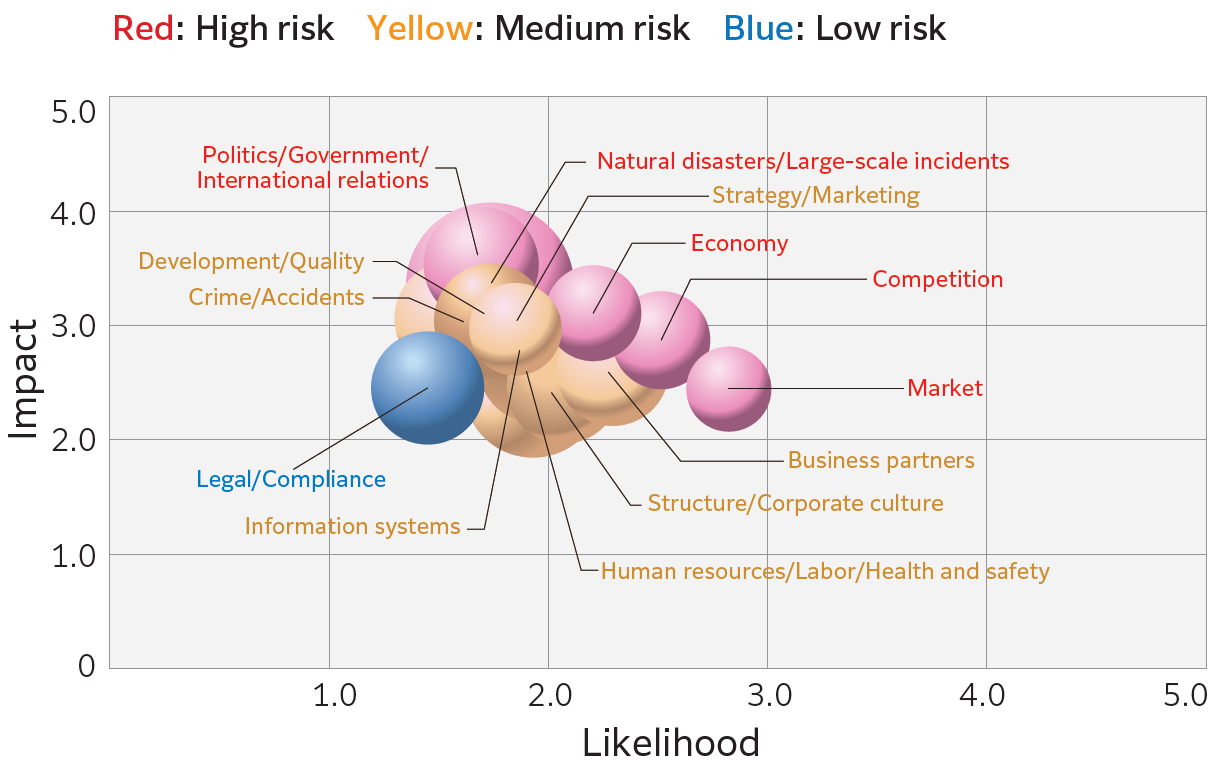
- Each company and department ranks the identified risks into five levels along the two axes of likelihood that the risk will materialize and impact if the risk should become reality.
- 3.Calculate risk scores
- A risk score is calculated for each risk by applying a separately determined set of criteria to the results of the risk assessments.
- 4.Create a risk map
- A risk map is created that represents each risk as a circle placed on a coordinate plane. The size of each circle depends on the risk score, and the location of each is dictated by its average likelihood and impact scores.
- 5.Determine risk severity
- Risk severity is determined for each risk by applying a separately determined set of criteria to the position of each on the risk map.
Main Risk Map Items
BCP Structure
Our Philosophy
As an essential business, the THK Group has a responsibility to supply parts even in the event of an incident that could potentially disrupt our operations. In order to fulfill that responsibility, the THK Group engages in a number of activities meant to ensure our business continuity, with our key strategies being prioritizing human life above all else, rapid recovery, and community collaboration.
Risk Management/BCP Structure

BCP Countermeasures
From the Hyuga-nada earthquake in January to the Aomori earthquake in December, a total of 4,456 earthquakes at or above seismic intensity 1 shook Japan in 2025, making it quite a seismically active year. In response to the Meteorological Agency first issuing its publication “Off the Coast of Hokkaido and Sanriku
Subsequent Earthquake Advisory” in the wake of December’s Aomori earthquake, THK instructed all our sales offices and production facilities in Japan to verify that all of their equipment was secured in place and that they each had an adequate stock of necessary supplies, and we directed all employees to double check their evacuation areas and the earthquake-proofing of their own residences.
When it was discovered that some locations had not conducted drills outside of daylight hours, we clarified rules stipulating that drills be conducted both during the day and at night to ensure safety in the dark as well.
In light of intensifying seismic activity and mounting risks to business continuity, THK continues to take measures to strengthen BCP collaboration across our supply chain and enhance our resilience as a company.
Information Security Structure
Our Philosophy
Recognizing the imperative of addressing constantly escalating risks to information security and the need to protect both our stakeholders and the business interests of the THK Group at large while complying with laws, guidelines, and other social norms related to information security around the world, we at THK are driving the following information security initiatives.
- (1)Maintenance of an information security management structure
- (2)Establishment of information security rules
- (3)Implementation of information security measures
- (4)Contractor management
- (5)Implementation of information security training and drills
- (6)Responses to information security incidents
- (7)Auditing and improvement of information security measures
Information Security Structure

ISO 27001 Certification
THK began offering its OEE Optimization System in 2020, and it has since been used by numerous customers for their production floors. However, in anticipation of expanding the service in the future and in order to afford customers greater peace of mind when using it, we have since had certified to the ISO/IEC 27001 international standard for information security management systems. Going forward, we will continue to provide highly reliable services by constantly striving to improve our information security.
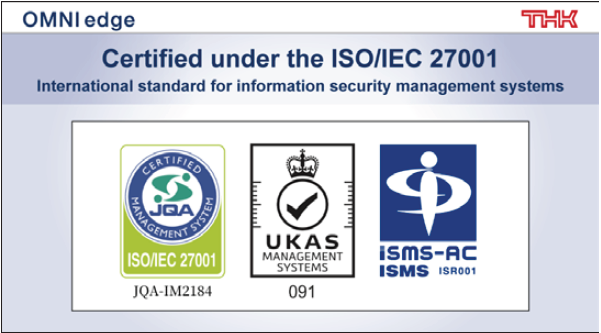
Registration number: JQA-IM2184
Registration date: November 4, 2025
Certifying body: Japan Quality Assurance Organization
Scope: Development, production, provision, and maintenance of an OEE optimization service; provision of cloud services; and configuration and shipment of related devices