Corporate Governance
Metrics and targets
Continue conducting annual evaluations of the effectiveness of the Board of Directors
Results
Annual evaluation performed by Results a third-party organization
Our Philosophy
We strive to maintain solid corporate governance in order to maximize our corporate value by sustaining growth through appropriate cooperation with our shareholders and other stakeholders.
Governance Structure
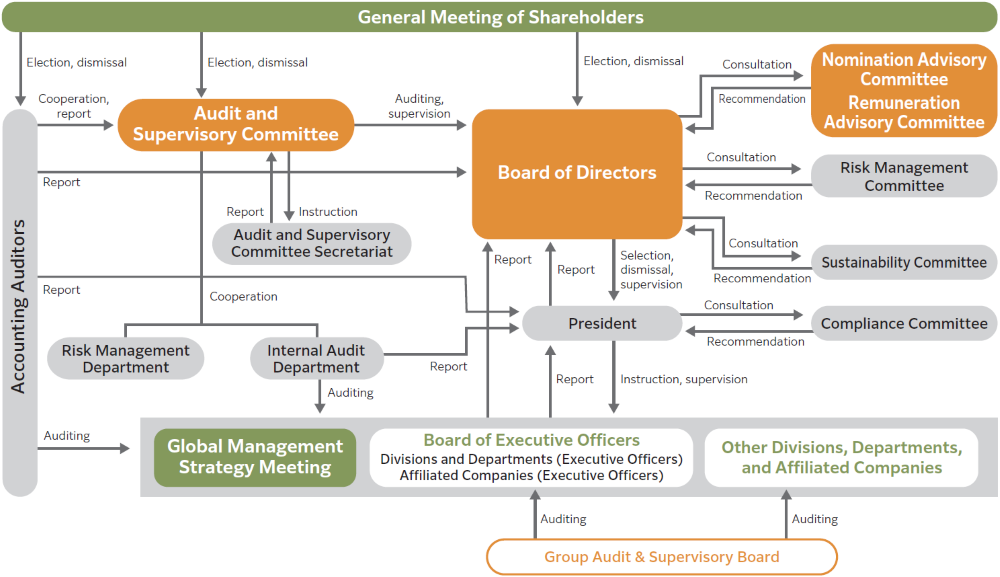
In conjunction with our establishment of an Audit and Supervisory Committee, THK instituted a non-mandatory Nomination Advisory Committee and a Remuneration Advisory Committee, each with an outside director majority, to ensure further transparency and fairness in management personnel and remuneration.
In addition, through our executive officer system, we have strengthened the auditing functions of the Board of Directors in addition to bringing greater speed and efficiency to management-related decision-making and the management of corporate affairs.
Board of Directors
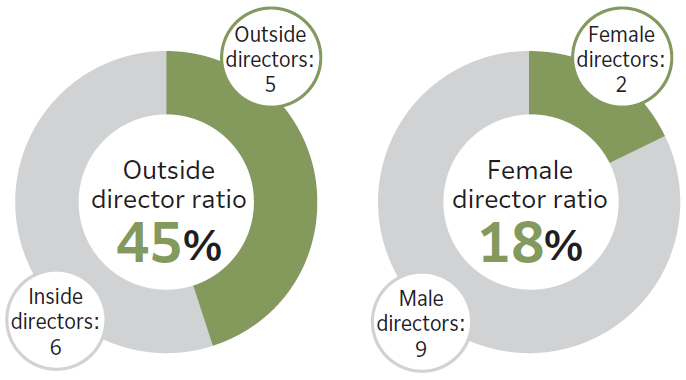
THK’s Board of Directors comprises a total of eight directors—including two outside directors—who are not members of the Audit and Supervisory Committee in addition to three outside directors who are Audit and Supervisory Committee members. The Board of Directors makes decisions on important matters of general management and carries out the oversight of directors and executive officers in the execution of their duties.
THK's five outside directors, whose independence meets the evaluation criteria stipulated by the Tokyo Stock Exchange and THK, possess specialized professional knowledge and qualifications related to corporate accounting, management, and other relevant skills. Accounting for over a third of our directors overall, they have further enhanced management neutrality, independence, and validity while improving the board's management oversight function.
Director Composition
Audit and Supervisory Committee
Comprising three outside directors who are Audit and Supervisory Committee members, the Audit and Supervisory Committee utilizes the internal control system to audit and supervise directors and executive officers with regard to the current status of the execution of their duties. The committee enhances the effectiveness of audits through its partnerships with an accounting auditor, the Internal Audit Department, and the Risk Management Department, which maintains and implements internal controls.
Additionally, an Audit and Supervisory Committee Secretariat has been established to assist in the smooth functioning of the committee by supporting its members and their work. The secretariat follows the instructions of the Audit and Supervisory Committee, coordinates with each department, and conveys instructions to the Internal Audit Department and the Risk Management Department.
Nomination Advisory Committee and Remuneration Advisory Committee
The Nomination Advisory Committee and Remuneration Advisory Committee are each composed of three directors, two of which are outside directors. This is in accordance with the rules for both committees, which stipulate that outside directors must make up more than half of the members and that each must also be chaired by an outside director.
As advisory bodies to the Board of Directors, both committees review and deliberate on director candidates and remuneration proposals, and they propose the content and outcomes of those deliberations to the Board of Directors. The Board of Directors conducts its own deliberations based on their proposals before deciding on a resolution.
Executive Officer System
By introducing the executive officer system, we have endeavored to accelerate decision-making and operational execution in addition to improving the management oversight function of the Board of Directors and clarifying roles and responsibilities relating to the management of corporate affairs.
THK has established both a Board of Executive Officers, attended by directors and executive officers, and a Global Management Strategy Meeting, attended by members of the Board of Executive Officers in addition to those in charge of each division, department, and affiliate company. These serve as forums for directors, executive officers, and other members of management to collaborate to share information across the Group and improve our corporate governance.
To clarify the roles and responsibilities of executive officers relating to the management of corporate affairs, an executive officer’s term in office is deemed to be one year.
Governance Structure
Participation in Board of Director and Committee Meetings
| Board of Directors (16/year) | Audit and Supervisory Committee (13/year) | Nomination Advisory Committee (5/year) | Remuneration Advisory Committee (2/year) | |
|---|---|---|---|---|
| Akihiro Teramachi | 100% | |||
| Takashi Teramachi | 100% | 100% | 100% | |
| Hiroshi Imano | 100% | |||
| Nobuyuki Maki | 100% | |||
| Naoki Kinoshita | 100%1 | |||
| Kenji Nakane | 100% | |||
| Junko Kai | 100% | 100%3 | ||
| Hiroko Kawasaki | 100%1 | 100%2 | ||
| Masakatsu Hioki | 100% | 100% | 100% | |
| Tomitoshi Omura | 100% | 100% | ||
| Yoshiki Ueda | 100% | 100% | 100% |
1 Naoki Kinoshita and Hiroko Kawasaki were appointed to the Board of Directors during the regular General Meeting of Shareholders held on March 15, 2025. They attended 13 of the 13 meetings held after that date.
2 Hiroko Kawasaki was appointed to the Nomination Advisory Committee to replace the outgoing Masaaki Kainosho on March 15, 2025. She attended four of the four meetings held after that date.
3 Junko Kai was appointed to the Remuneration Advisory Committee to replace the outgoing Masaaki Kainosho on March 15, 2025. She attended the one meeting held after that date.
Board of Directors Skill Matrix and Reasons for Selection
Board of Directors Skill Matrix
| Corporate management | Global business | Corporate finance | Development, production, and innovation | IT and digital technology | Human resources, talent, and corporate culture | Laws, risk, and governance | Sustainability | |
|---|---|---|---|---|---|---|---|---|
| Akihiro Teramachi | ● | ● | ● | ● | ● | |||
| Takashi Teramachi | ● | ● | ● | ● | ● | |||
| Nobuyuki Maki | ● | ● | ● | |||||
| Naoki Kinoshita | ● | ● | ||||||
| Kenji Nakane | ● | ● | ● | |||||
| Nobufumi Sato | ● | ● | ||||||
| Junko Kai | ● | |||||||
| Hiroko Kawasaki | ● | ● | ● | ● | ||||
| Yoshiki Ueda | ● | ● | ● | |||||
| Masakatsu Hioki | ● | ● | ● | |||||
| Tomitoshi Omura | ● | ● |
Reasons for Selection
| Corporate management | As we secure a firm understanding of megatrends in the midst of a volatile business environment while also sustainably improving our corporate value over the medium to long term in pursuit of our management policy of achieving an ROE greater than 10% as quickly as possible, we require directors who possess a wealth of management experience (including in sales and marketing). |
|---|---|
| Global business | As we provide products and services tailored to the characteristics of various regions and markets to accelerate our full-scale globalization efforts, we require directors who possess knowledge and experience related to those industries and regions into which our business expands (including in sales and marketing). |
| Corporate finance | As we manage the performance of our highly disciplined growth investments, appropriate financing, and shareholder returns to operate our business with a focus on capital efficiency in pursuit of our management policy of achieving an ROE greater than 10% as quickly as possible, we require directors who possess knowledge and experience related to finance, accounting, and corporate finance. |
| Development, production, and innovation | As we develop innovative products and services and continuously generate original production technologies as a company focused on creation and development, we require directors who possess knowledge and experience related to development, production, and innovation. |
| IT and digital technology | As we make our work processes more efficient by strengthening our IT environment and promoting DX, and as we generate new value by fostering innovation in how we do business, we require directors who possess knowledge and experience related to IT and digital technologies. |
| Human resources, talent, and corporate culture | As we engender a corporate culture that encourages people to challenge themselves with new endeavors while also passing down traditions to the next generation, and as we create an environment where diverse talent can thrive under the philosophy of thoroughly strengthening what needs to be strengthened and bravely changing what needs to be changed, we require directors who possess knowledge and experience related to human resources, talent, and corporate culture. |
| Laws, risk, and governance | As we strengthen the legal compliance and corporate governance that serve as the foundation of our corporate activities, and as we conduct proactive risk management to aggressively promote full-scale globalization and the development of new business areas, we require directors who possess knowledge and experience related to laws, risk, and governance. |
| Sustainability | As we devote all of our corporate activities to the twin goals of responding to environmental and social challenges while also improving our corporate value and contributing to the creation of a sustainable and affluent society, we require directors who possess knowledge and experience related to sustainability. |
Evaluating the Effectiveness of the Board of Directors
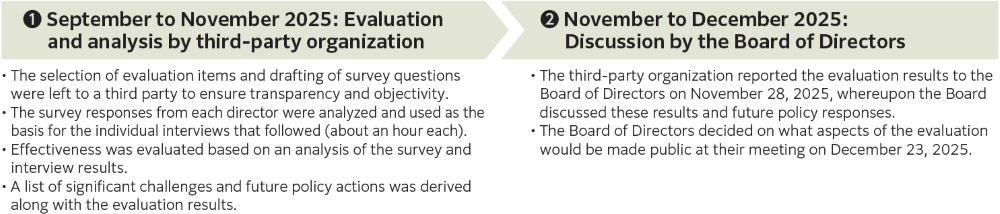
We conduct an annual survey on the capabilities of the Board of Directors in order to ensure its effectiveness and improve its performance.
In 2025, as in 2024, this survey and interviews with each director were conducted through a third-party organization.
Purpose of the 2025 Third-Party Evaluation
At the time of the 2024 evaluation of the effectiveness of the Board of Directors (the previous year’s evaluation), THK determined that developing our corporate governance to promote management that emphasized profitability and capital efficiency required specialized, objective evaluation of the effectiveness of activities undertaken to enhance our corporate value. As a result, a third-party organization was enlisted to perform such an evaluation of the effectiveness of the Board of Directors.
Overview of the 2025 Evaluation
| People being evaluated | All 11 directors |
|---|---|
| Evaluator | Third-party organization |
| Evaluation method | Individual interviews and a survey |
| Evaluation period | September to December 2025 (including preparation period) |
| Evaluation items | 1. Matters addressed and measures taken in 2024 2. Structure of the Board of Directors 3. Operation of the Board of Directors 4. Content of Board of Director discussions and proposals 5. Information sharing with outside directors 6. Nomination Advisory Committee and Remuneration Advisory Committee 7. Director contributions and self-evaluations 8. Overall evaluation of the Board of Directors 9. Individual evaluations of Board of Directors meeting topics |
2025 Evaluation Process
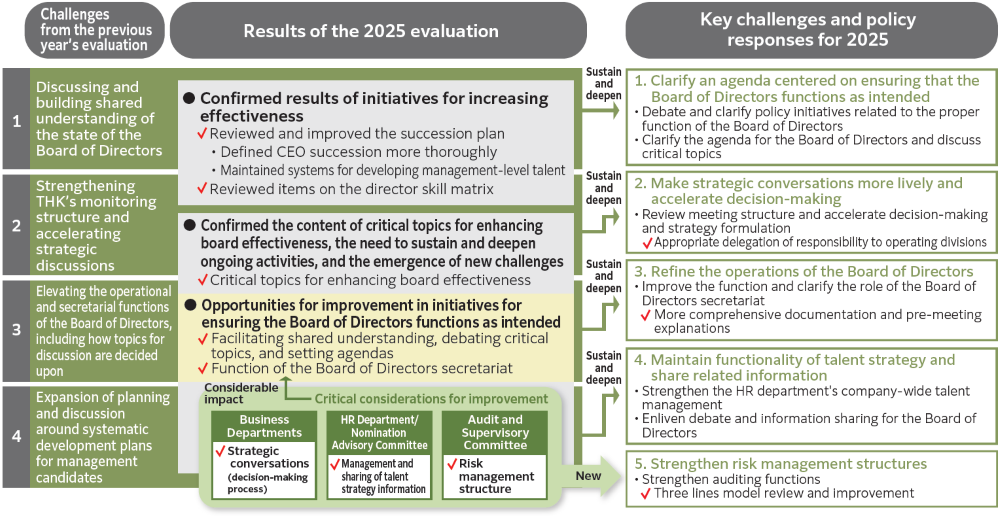
2025 Results and Policy Responses
- It was confirmed that the review of the succession plan, the review of the director skill matrix, and the more lively discussion that arose in response to the results of the previous year’s evaluation enhanced the board's effectiveness.
- As a result of reviews conducted to make further improvements, the content of critical topics for enhancing board effectiveness, the need to sustain and deepen the previous year’s activities, and the emergence of new challenges were all confirmed.
- The Board of Directors decided on policy responses and general measures to take in light of these analyses and evaluations.
Succession Plan
| Overview | In order to ensure business continuity and enhance medium- to long-term corporate value, THK has established and maintains a succession plan for the position of Chief Executive Officer (CEO). This succession plan is intended to support our continual growth as a company focused on creation and development while reflecting THK’s philosophy and values, and it is promoted within the context of a governance structure that prioritizes transparency and accountability. |
|---|---|
| Process | THK’s succession plan uses the following process to develop the next-generation of leaders. |
| Other: Emergency response (BCP response) | To minimize succession risks, THK has a clearly defined short-term structure to account for a CEO’s absence and maintains an emergency response framework to prevent gaps in executive leadership. |
| Future developments | THK will continue to develop next-generation leaders who embody our corporate philosophy and are capable of flexibly responding to a business environment defined by drastic change. We will refine our governance and the way we manage human capital to make our management structure an ever stronger driver of sustainable growth. |
Executive Compensation
Basic Policy
It is our basic policy that the remuneration structure for directors (excluding directors who are Audit and Supervisory Committee members and outside directors) will be tied to shareholder interests in order to ensure that such compensation functions effectively as a continued incentive to improve corporate value, and decisions on remuneration for individual directors are based on an appropriate standard in consideration of their duties.
Base Salaries
The annual sum of all director base salaries is held at or below ¥1.2 billion, no more than ¥120 million of which may go to outside directors. These base salaries are determined by the Board of Directors using a ranking system they have created to account for the scope of each individual’s roles and responsibilities. These determinations reflect reviews and reporting from the Remuneration Advisory Committee and use the compensation structures of other manufacturing companies on the Prime Market with comparable operating incomes as a baseline.
The annual base salaries of outside directors must remain under ¥120 million, and the amount is determined based on compensation standards for companies of a similar size, industry, and type of business.
Performance-Based Incentives
Performance-based compensation is determined by business performance and individual KPI evaluations. Compensation tied to business performance corresponds to THK’s ROE, starting at zero and scaling linearly with benchmark ROE values. Personal KPI evaluations take both quantitative and qualitative metrics into account. Performance-based incentives are not provided to outside directors.
Restricted Stocks
As an incentive to continuously improve THK’s corporate value, restricted stocks are provided to directors (excluding directors who are Audit and Supervisory Committee members and outside directors). In order to align the interests of directors with those of shareholders, these stocks may not be transferred except under specific circumstances, and when such conditions are met, they will be allocated as common stocks, which are subject to restrictions such as being allotted without contribution.
Furthermore, based on a resolution by THK’s Board of Directors, the annual sum when combined with the base salary shall not exceed ¥1.2 billion (no more than ¥120 million of which may go to outside directors), and no more than 270,000 common shares may be allocated to directors (excluding directors who are Audit and Supervisory Committee members and outside directors).
Compensation Structure Policy
The Board of Directors determines the proportion of each type of compensation based on each director's role and rank, taking into account reviews and reporting from the Remuneration Advisory Committee, more than half of whose members, including the chairperson, are outside directors.