Progress under the New Management Policy: Achieve an ROE Greater than 10% as Quickly as Possible
Thoroughly Strengthen What Needs to Be Strengthened and Bravely Change What Needs to Be Changed
Projects and Progress toward an ROE Greater Than 10%
In November 2024, THK announced our new management policy of achieving an ROE greater than 10% as quickly as possible. To promote management that emphasizes profitability and capital efficiency in order to achieve this target, we are employing a strategy of selection and concentration based on capital costs, making highly disciplined investments to bolster competitiveness for the sake of sustainable growth, and reviewing our capitalization strategies. We are also transforming our corporate governance structure to further augment these efforts. For the first two years under this new management policy, we are driving structural reforms at all levels to become a lean, highly profitable business. Then, between 2027 and 2029, we will achieve an ROE greater than 10%.
Roadmap for an ROE Greater than 10%
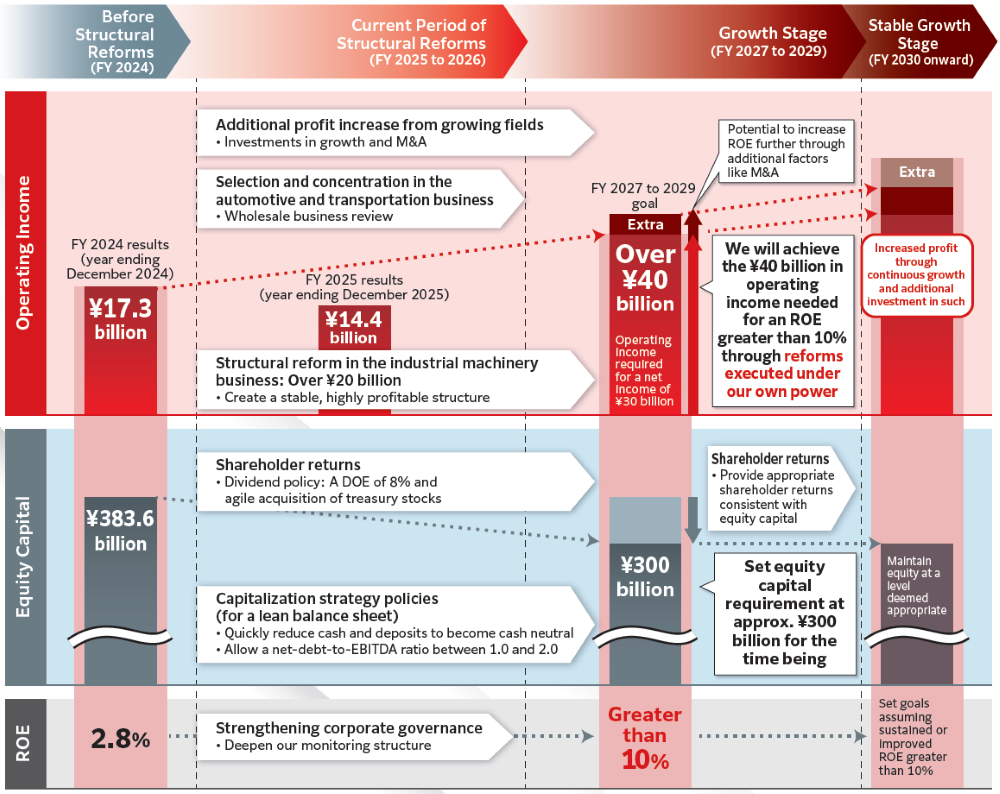
On February 2, 2026, the Board of Directors resolved to transfer ownership of the automotive and transportation business, as this was determined to be the proper course of action in light of a strict evaluation of the segment’s anticipated future capital costs and ROIC. This marked the conclusion of the selection and concentration process for the automotive and transportation business.
For the industrial machinery business, the president issued a statement to all employees and visited facilities within and outside of Japan to personally speak on THK’s current environment, the goals we must achieve, and his expectations for the future, all to create the shared awareness among all employees required for us to achieve our goals. In terms of execution, THK has also launched the ROE 10 Project, which calls together different functional and goal-defined working groups and is driving various activities bolstered by the support of outside experts.
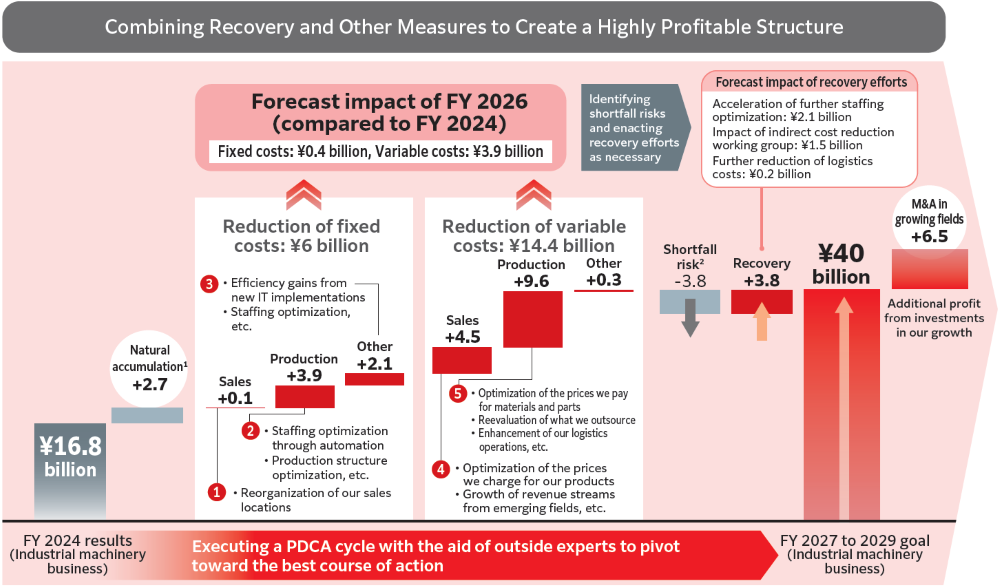
1 This natural accumulation value combines our 2025 forecast at the time the new management policy was announced, forecast sales revenue for 2027 to 2029 that assumes an average growth rate of 2% per year, and projected labor costs assumed to increase by just over 4% per year, on average.
2 This value does not include factors that caused temporary reductions or negative impacts of the volume effect from FY 2025.
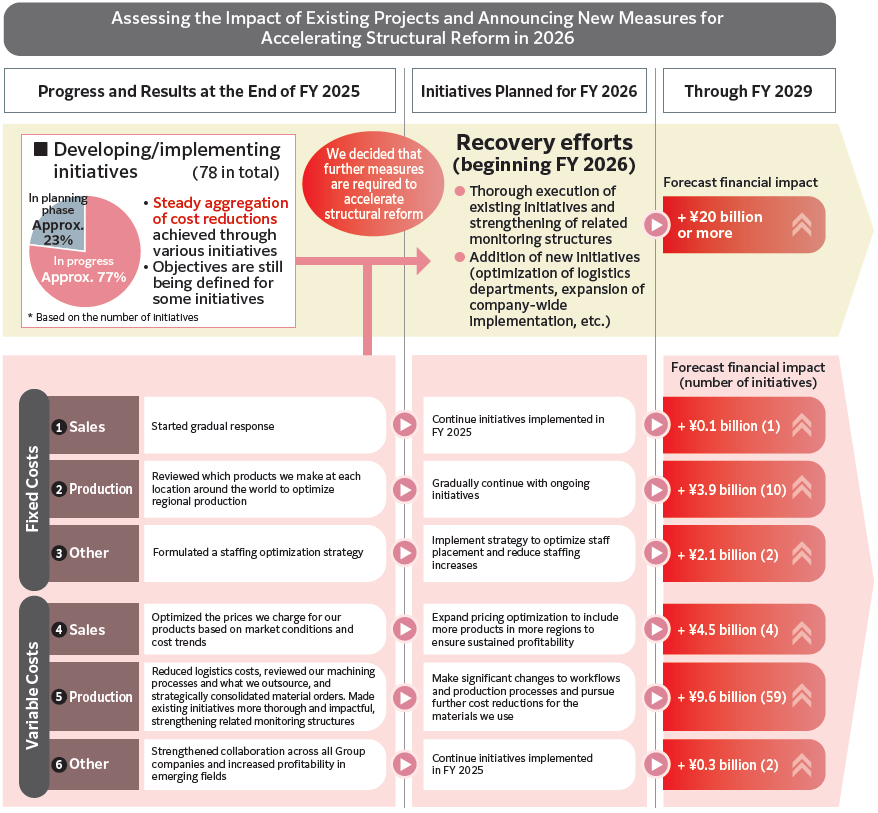
In 2025, we launched a total of 78 different initiatives, 77% of which are currently underway. The remaining 23% have not yet been implemented, as their objectives are still being defined. To address our fixed costs on the sales side of our operations, we began with a review of select sales offices, which we are continuing in 2026. On the production side, we are reviewing which products we make at each location around the world to optimize regional production in 2026 and beyond. We have also formulated a staffing optimization strategy that will be executed starting this year to further reduce our fixed costs. To address variable costs in our sales operations, we focused primarily on price optimization within Japan. As demand continues to grow, we expect to see the impact of these activities become increasingly relevant. In 2026, we intend to expand the scope of our price optimization efforts to further magnify their effect. For our production operations, we have worked to make existing initiatives more thorough and impactful, strengthening related monitoring structures. We have made progress toward reducing logistics costs, reviewing our machining processes and what we outsource, and strategically consolidating material orders. In 2026, we are making significant changes to workflows and production processes and pursuing further cost reductions for the materials we use. Even as we pursue these initiatives, we are well aware of inflation and other headwinds that pose the risk of making our plans fall short. In order to offset this risk and ensure that we achieve our goals, we will further invest in recovery measures starting in 2026. These measures include accelerating further staffing optimization, adding more working groups focused on driving down indirect costs, and further reducing logistics costs.
Increasing Profit from Growing Fields
For the machine component side of our industrial machinery business, we have combined our global business foundation with global task forces created to focus on seven key growth fields, including the semiconductor industry. This allows us to address the needs of different industries and regions with a high degree of focused specificity. As a result of changes made to the structure of our development division to bolster our ability to discover the needs of cutting-edge fields globally and to ensure that our systems are more closely aligned with these needs, we also anticipate a considerable rise in the number of planning and development projects we undertake in the future.
Meanwhile, the FA solution business is successfully expanding upon new products and services developed for the growing areas of mechatronic modules, the IoT, and AI in order to respond to the needs of both machine builders and a wide array of machine users. We will also drive further growth in this realm by actively engaging in business collaborations and M&A to supplement the functionality we are already able to offer.
Balance Sheet Management That Emphasizes Capital Efficiency
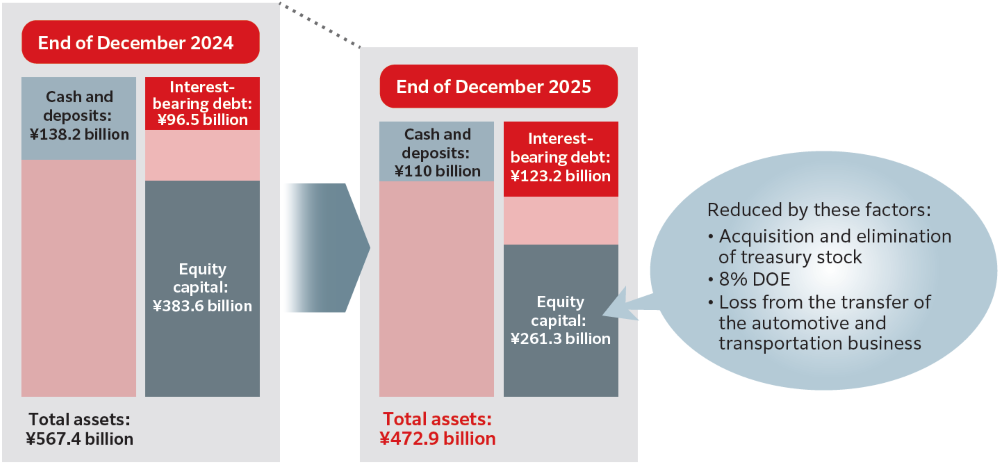
The ¥81.6 billion recorded as a business liquidation loss from the transfer of shares and credits from the automotive and transportation business led to a loss of ¥69.8 billion for the 2025 fiscal year. However, THK was able to eliminate the entire ¥40 billion in treasury stocks outlined in its capitalization strategy policy for achieving an ROE greater than 10% as quickly as possible. We also sustained a DOE that allowed us to continue paying high dividends and reduced equity capital by ¥122.3 billion year on year. Furthermore, while we will maintain a DOE of 8% until we achieve our goal of an ROE greater than 10%, even after that task is accomplished, we will not only hold our ROE above our shareholders' equity costs, but enhance it further to ensure that we can continue to provide stable returns to our shareholders.
Strengthening of Corporate Governance
In order to enhance the effectiveness of all these initiatives, THK has undertaken several efforts to improve its corporate governance, from continuing with third-party evaluations of the effectiveness of the Board of Directors and reviewing the board's composition and skill matrix to updating our executive compensation system to better incentivize efforts to improve corporate value, reevaluating our personnel evaluation system, and drafting a succession plan. We also revised our director skill matrix, assessing each director's capabilities with eight newly selected requisite skills that align with our management policy and are conducive to sustainably increasing corporate value.
Beyond an ROE Greater than 10%
In these ways, we will not only achieve an ROE greater than 10% as quickly as possible, but push further to raise our ROE beyond our shareholders' equity costs for the sake of increasing corporate value to ensure that we can continue to provide stable returns to our shareholders.