Business Strategy: Industrial Machinery Business
Reflecting on the 2025 Fiscal Year
In 2025, we saw revenue rise to ¥240.4 billion, a 7.9% increase from the previous fiscal year. At the same time, however, our operating income fell to ¥14.4 billion, a decrease of 9.3% from the previous year. Despite heightened geopolitical risks, ongoing inflation, and US tariffs that collectively made our external environment more unpredictable, demand in the Chinese and American markets held strong. This was not the case, however, for the Japanese and European markets. In the Japanese market, where we had expected to see a recovery centered on the semiconductor industry, demand remained lower than our early forecasts predicted. Even as our revenue increased, our operating income suffered from a worsening sales mix, the impact of US tariffs, equity losses, costs associated with our business reforms, and various cost increases. These factors, combined with ¥81.6 billion recorded as a business liquidation loss from the transfer of shares and credits from the automotive and transportation business, led to a loss of ¥69.8 billion for the year. However, by focusing our corporate resources on the industrial machinery business, we are already working toward greater growth in the future.
On the sales front, our machine component business has been cultivating key fields and leveraging global information sharing to communicate demand trends in different countries and regions. We have created systems within our product development process that increase our points of contact with customers to give us a better understanding of their needs, allow us to address those needs by properly allocating limited development resources, and ensure that new products are brought to market quickly. In keeping with our business reforms, our manufacturing operations have worked to transition to a lean business model that allows us to make our products in a way that sustains a high level of profitability.
Aligning Strategy and Action with the New Management Policy
As we reform our industrial machinery business in line with our new management policy, we continue to rigorously monitor results and implement further actions where these fall short as part of a PDCA cycle that will increase our effectiveness and transform us into a leaner business.
As physical AI becomes an ever-growing presence in manufacturing worldwide, we are working to further expand our business domains by honing our growth strategies of full-scale globalization, the development of new business areas, and a change in business style. For our
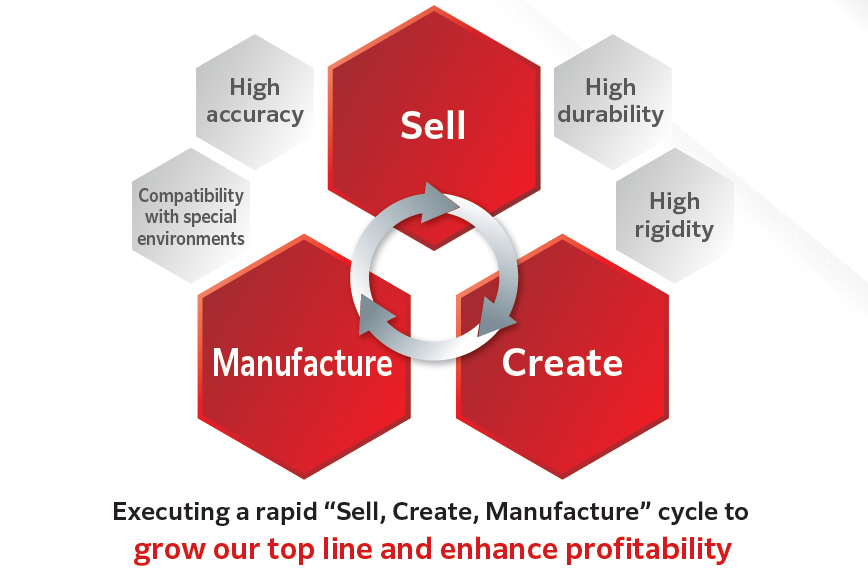
machine component business, we have combined our existing business foundation with global task forces created to focus on seven key growth fields, including the semiconductor industry. This allows us to address the needs of different industries and regions with a high degree of focused specificity. As a result of changes made to the structure of our development division to bolster our ability to discover the needs of cutting-edge fields globally and to ensure that our systems are more closely aligned with these needs, we also anticipate a considerable rise in the number of planning and development projects we undertake in the future. Using reference data from past research and development projects, we are working on a variety of measures to reduce development time by two thirds and expect this to result in at least twice as many new products going to market in 2026 as did in 2025. Through all of these efforts, we are working to maximize deployment of our global branding while executing a rapid cycle of selling, creating, and manufacturing to grow our top line, enhance profitability, and maximize final profit.
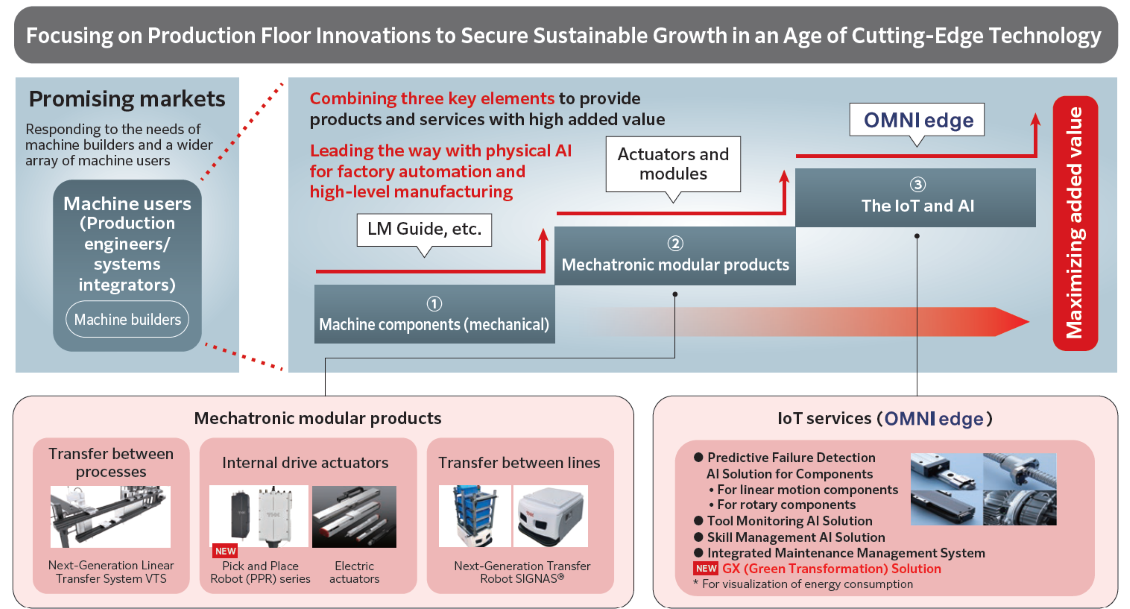
The FA solution business, on the other hand, has worked to develop new products and services in the growing areas of mechatronic modules, the IoT, and AI for the sake of responding to the needs of both machine builders and a wide array of machine users faced with production floors made ever more complex by social issues like automation, labor shortages, and sustainability. While this aspect of our business is still small in scale, it is steadily growing, having already yielded new products whose sales have at least doubled year on year. Looking ahead, as physical AI technology continues to mature, we anticipate the rise of software-defined factories that run 24 hours a day, 365 days a year thanks to factory-wide, AI-driven simulation and hardware control as well as ongoing AI learning. These factories will require THK's durable machine components to provide stable machine operation, and we expect the data requirements of AI simulations and AI learning to drive demand for the sensing technology we have refined with our IoT services as well. At the same time, we are focusing our energy on developing smart subsystems that combine actuator, sensing, and control technologies to support the world of physical AI and ensure the sustainable growth of our company.
In order to achieve these various aims, we are also working to strengthen initiatives aimed at maximizing human capital. For example, we are reevaluating our performance bonus fund, enhancing evaluation feedback in our HR system, and making our evaluation process more transparent overall. Looking ahead, as we promote shared commitment to our PMVV statement, we will further accelerate our efforts to transition to a new compensation system that values a balanced approach, revise our evaluation system, clarify career paths, and conduct engagement surveys to assess and improve employee satisfaction while also implementing talent management systems to elevate the skill level of our employees. By pursuing these reforms and reshaping ourselves into a company that rewards those who work hard and produce results, we are building a foundation for sustainably increasing our corporate value.